
Road work ahead: ASIC releases roadmap for digital assets bill
24/04/2026
Following the passage of the Corporations Amendment (Digital Assets Framework) Act 2026 (Cth) (DAF Act) earlier this month, ASIC has published its roadmap for implementing Australia’s new digital assets regulatory framework. The roadmap outlines ASIC’s planned consultation and implementation program over the next 18 months ahead of commencement in April 2027, covering two new financial products: digital asset platforms (DAPs) and tokenised custody platforms (TCPs).
This is a welcome development for industry, as now the dust has settled on the primary legislation, attention is turning to the regime’s practical requirements including licensing authorisations, operational standards and transitional arrangements. For many platforms that have historically operated in regulatory grey areas, the roadmap promises a clearer outline of how ASIC intends to regulate the sector once the new law takes effect.
This clarity is particularly important given ASIC’s updated INFO 225 guidance released during the consultation phase of the DAF Bill. That guidance reinforced ASIC’s position that most widely traded crypto‑assets are financial products, with only a relatively narrow category of tokens likely falling outside the financial product perimeter. As a result, businesses engaging with crypto-assets are required to undertake token‑by‑token assessments to determine the legal character of the assets they deal with or custody, and the licence authorisations required under the existing laws. INFO 225 does not yet address the additional requirements for DAPs or TCPs, making the forthcoming regulatory guide updates and standards critical in clarifying how the new regime is intended to operate in practice.
ASIC describes an 18‑month staged implementation, divided broadly into four phases.
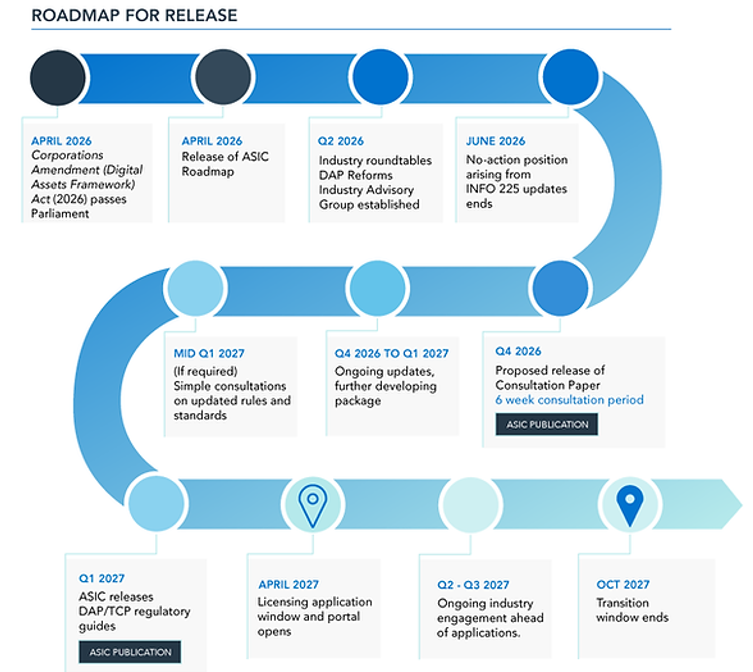
- Phase 1: Months 1–6 will focus on industry consultation and engagement, with existing licensing obligations continuing to apply following the expiry of the INFO 225 class no action position in June 2026.
- Phase 2: Months 6–12 will see:
- 2.1 ASIC release new regulatory guidance for DAPs and TCPs, clarifying when licensing is required and how the new regime operates (slated to be read alongside INFO 225);
- 2.2 Updates to existing ASIC regulatory guides, including RG 1 (Applying for and varying an AFS licence) and RG 166 (AFS licensing: Financial requirements), with potential consequential updates to other materials (including INFO 225);
- 2.3 Consultation on, and rollout of, legislative instruments setting standards, including
- asset holding standards (s 912BE);
- transactional and settlement standards (s 912BF); and
- baseline financial requirements aligned to existing AFSL settings,
- 2.4 ASIC has signalled flexibility for different business models (custody only, brokered, exchange style, vertically integrated structures) and whether assets are financial products.
- Phase 3: Months 12–18 will involve the opening of licence applications for DAP and TCP operators, with transitional regulatory relief available while applications are assessed. ASIC hints at a potentially streamlined approach for licence variations involving entities recently licensed under the AFSL regime.
- Implementation: Month 18 onwards sees the new regime being fully operational, with licensing arrangements in place and ASIC supervision and oversight.
Conclusion
ASIC’s roadmap marks a meaningful step toward regulatory clarity for Australia’s digital asset sector, shifting the focus from primary legislation to practical implementation. While the direction of travel is now clearer, many important aspects will be shaped by forthcoming ASIC guidance and legislative instruments, meaning material uncertainty remains, particularly once INFO 225 no‑action relief expires. This staged, guidance‑led approach reflects broader international trends, where supervisory detail is proving decisive in shaping market outcomes. Against that backdrop, the next 12 to 18 months will be critical not only for digital asset businesses to assess licensing pathways and prepare for compliance, but also for Australia to ensure the regime supports new market entrants while remaining competitive as a destination for digital asset activity.
Written by Steven Pettigrove, Katrina Sharman and Tahlia Kelly
| Disclaimer: This publication is for general information only and is not legal advice. You should seek specific legal advice for your own circumstances. |